OMNIKON://WHY PROMPT STRINGS DON'T SCALE IN PRODUCTION
bash
$ cat /omnikon/system/why prompt strings don't scale in production.md
Why Prompt Strings Don't Scale in Production
# Why Prompt Strings Don't Scale in Production If you've built an AI application, you've probably...
Omnikon Contributor
3 min read0 viewsJul 10, 2026
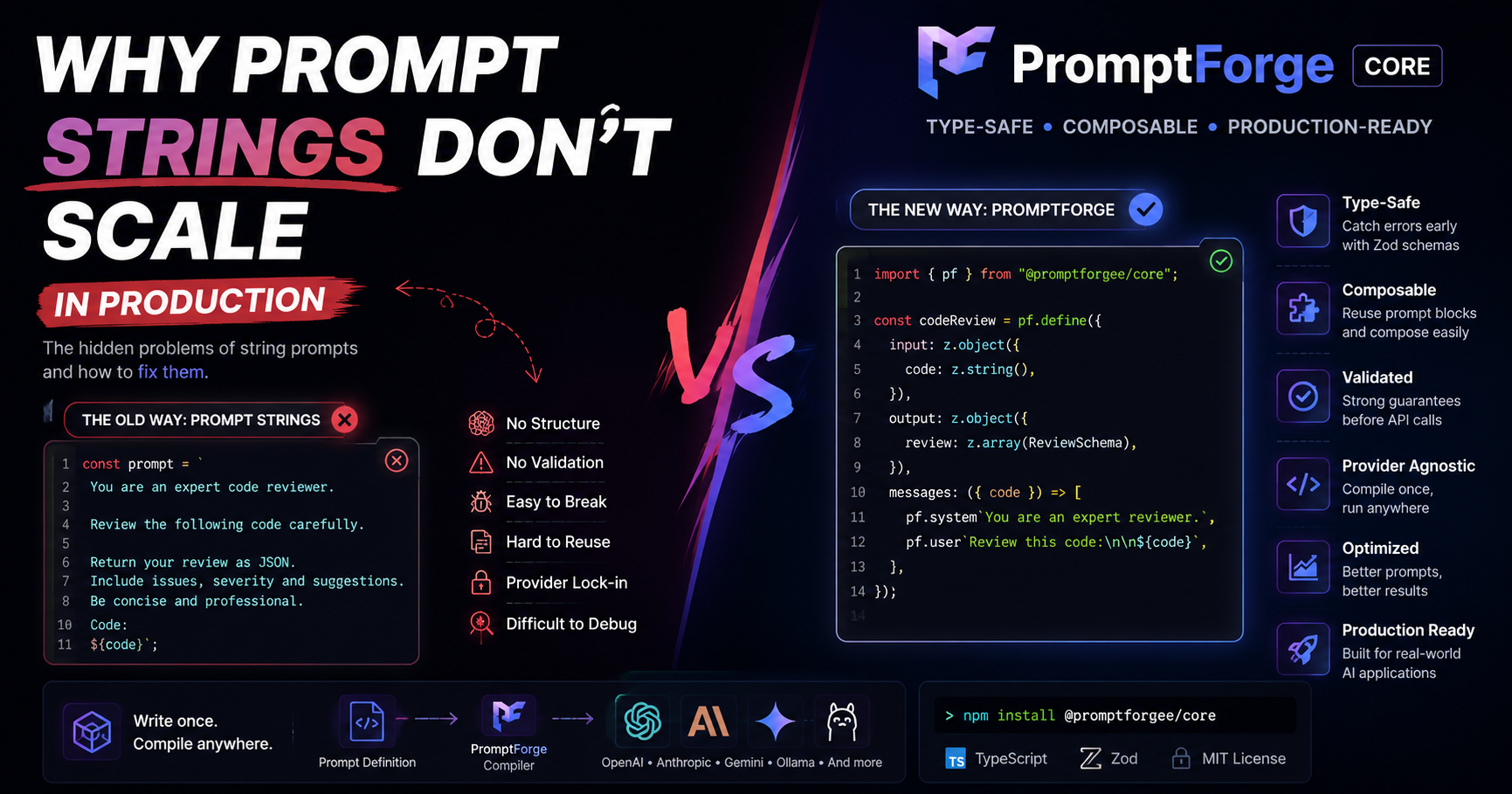# Why Prompt Strings Don't Scale in Production
If you've built an AI application, you've probably written prompts like this:
ts
const prompt = `
You are an expert software engineer.

Review the following code.

Return only valid JSON.

Include a severity score.

Do not explain your reasoning.

${code}
`;
It works.
Until it doesn't.
As AI applications grow, prompts stop being "just strings."
They become **business logic**.
Unfortunately, most projects still treat them like text files.
---
The Hidden Problem
At first, your project has one prompt.
Then five.
Then twenty.
Soon you have prompts scattered across your codebase.
Prompt Engineering Is Becoming Software Engineering
Modern AI systems are no longer one-off prompts.
They're made of
Agents
RAG pipelines
Tools
Structured Outputs
Function Calling
Multi-step workflows
Prompts deserve the same engineering practices we apply everywhere else.
They should be
Reusable
Testable
Composable
Versioned
Type-safe
---
A Better Approach
Instead of writing prompts as strings...
Treat them like code.
ts
const summarize = pf.define({

  input: z.object({
    text: z.string(),
  }),

  output: z.object({
    summary: z.string(),
  }),

  messages: ({ text }) => [

    pf.system`
      You are an expert summarizer.
    `,

    pf.user`
      Summarize:

      ${text}
    `

  ]

});
Now your prompt has
✅ Validation
✅ Type inference
✅ Structure
✅ Reusability
✅ Composability
Instead of hoping your prompt is correct...
Your tooling helps guarantee it.
---
Prompt Engineering Needs Better Tooling
We already have amazing tools for software engineering.
TypeScript gives us type safety.
ESLint catches mistakes.
Prettier formats code.
Testing frameworks catch regressions.
Prompt engineering deserves the same ecosystem.
That's one of the reasons I started building **PromptForge**—an open-source TypeScript toolkit for building, validating, composing, and optimizing prompts as reusable software components rather than fragile strings.
The goal isn't to replace prompt engineering.
It's to bring modern software engineering practices to it.
---
What's Next?
In the next article we'll build our first production-ready prompt using PromptForge and see how type-safe prompt definitions make AI applications easier to maintain.
---
Resources
📦 npm
bash
npm install @promptforgee/core
🌐 Documentation
https://prompt-forge-docs.vercel.app/
⭐ GitHub
https://github.com/Omnikon-Org/PromptForge
---
If you've ever spent hours debugging a prompt because of a missing variable or duplicated instructions, I'd love to hear your experience.
What has been the biggest challenge you've faced while managing prompts in production AI applications?
